8 key factors for a better sound environment
A well-designed environment is about more than what you see. Understanding how sound behaves in a space is essential when planning a workplace that truly works. Here, you’ll learn what makes a difference.
When sound is managed in the right way, it creates better conditions for focus, conversation and concentration, without taking away the openness or energy of a space.
Acoustics and spatial design are not separate layers, but part of the same whole. A way to create environments that work in everyday use, over time. It is also a key part of how we experience a place.
"This is how we contribute to better environments – every day. This is where the journey begins."
Human hearing has historically been essential for our survival. It may be why it is always active. What once helped us detect danger can today make it harder to find calm, stay focused and work without interruption.
In a modern workplace, this constant alertness can become a challenge. Sound comes from many directions, and the human voice is especially difficult for the brain to filter out. Conversations and background noise draw our attention, interrupt our focus and, over time, leave us feeling mentally fatigued.
"A good sound environment rarely happens by itself. It is the result of conscious choices in how a space is planned, furnished and supported with the right acoustic solutions."
Four fundamental principles for a better sound environment
We begin with the toolbox — four acoustic principles that form the foundation of many solutions used in modern workplaces. These are absorption, diffusion, reduction and screening, and blocking.
1. Absorption
REMOVING SOUND. Absorption is the foundation of a good sound environment. By using materials that capture sound waves, it is possible to reduce unwanted noise in a space, especially voices, and create better conditions for focus and conversation. This is where acoustic solutions make the biggest difference. Absorption is the only way to actually remove sound from a room. When a sound wave hits an absorbent surface, the sound energy is broken down within the material and disappears.

Managing sound through absorption
What absorption does to sound
Absorption is the most important factor when improving the sound environment in a room. It is also the only way to permanently remove sound.
When sound waves hit an absorbent material, the energy is broken down within the material and converted into heat. The temperature change is barely noticeable, but the sound energy disappears. The result is a calmer and more controlled sound environment.
Thickness and frequency
To effectively absorb human speech, an absorbent should be at least 40 mm thick. Lower and deeper tones have longer sound waves and are more difficult to capture, which places higher demands on the thickness and material of the absorbent.
Higher-pitched voices are generally easier to reduce, while deeper voices are more likely to pass through if the absorbent is too thin. The longer the sound wave, the thicker the material needed to stop it.
Placement of absorbents
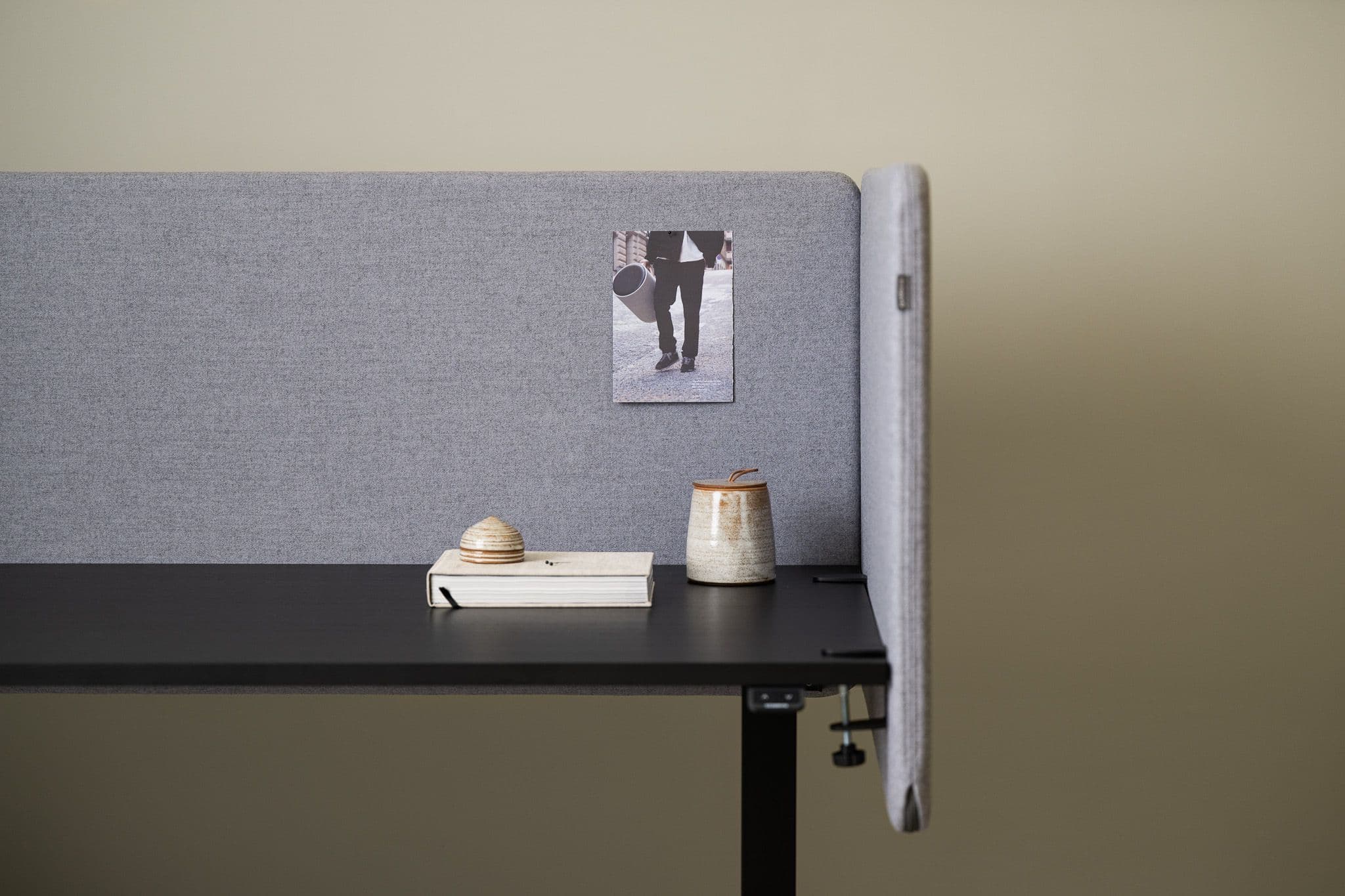
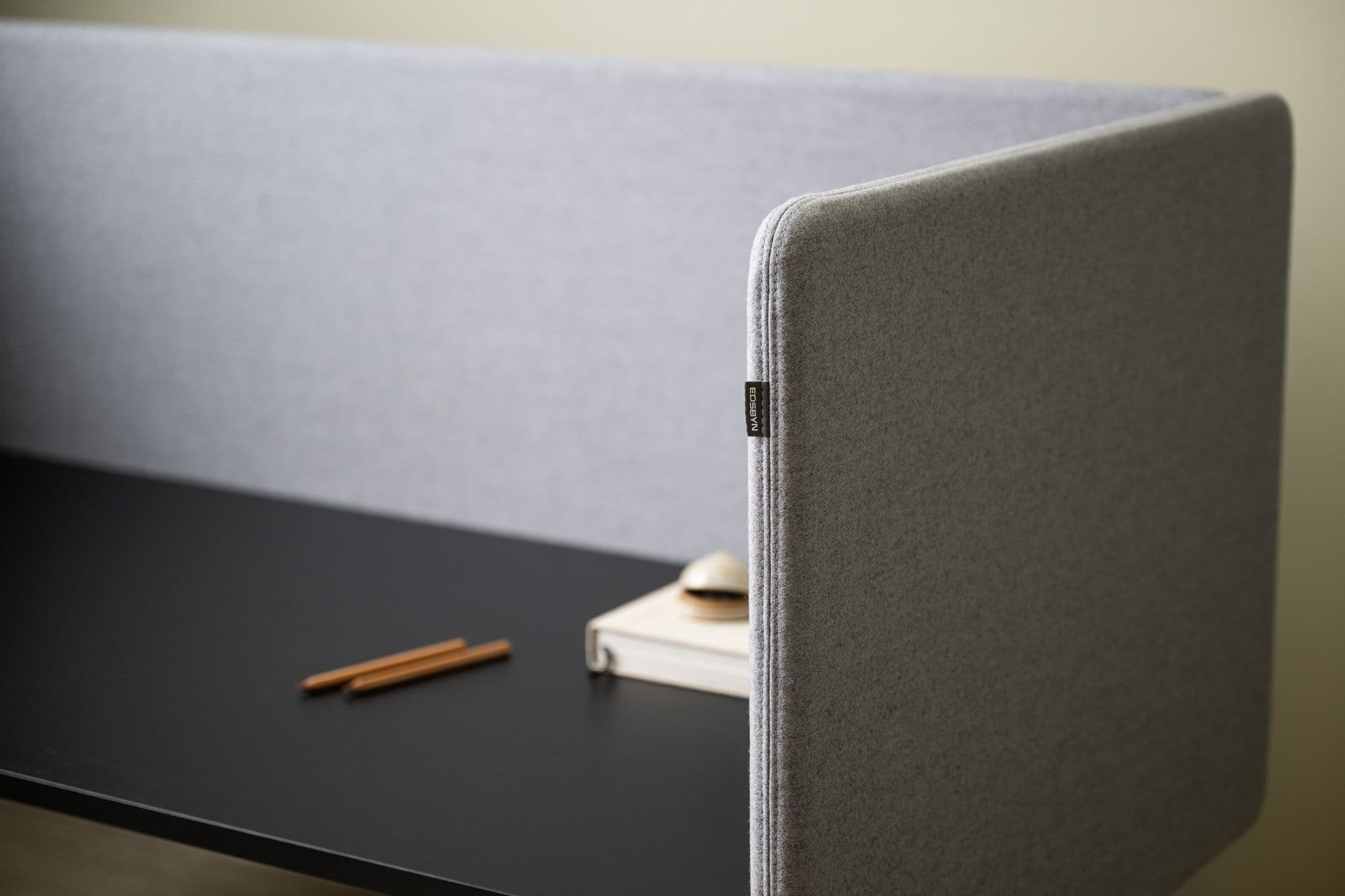
The placement of an absorbent is just as important as the material itself. For example, a desk screen should be high enough to cover the mouth level of the person sitting at the desk. If the screen is too low, sound can pass over it.
Wall-mounted absorbents are often placed at a height of around 100 to 150 cm from the floor, where they effectively capture sound from conversations in the room.
Rules of thumb for the room
A common guideline is that around 15 percent of the wall surface in a room should be covered with absorbents to create a good sound environment. This assumes that the room also has a sound-absorbing ceiling. If the ceiling lacks absorption, additional measures are needed.
A simple way to increase effectiveness is to install wall absorbents with a small air gap behind them, for example 40 mm from the wall. This can significantly improve absorption compared to mounting the panel directly against the wall.
WHAT HAPPENS TO THE SOUND?
The sound wave enters a soft material and disappears.
PRINCIPLE
Absorbent materials capture sound waves and convert the energy into heat.
RESULT
A quieter and more comfortable sound environment.
TYPICAL SOLUTIONS
Desk screens, wall absorbents, floor screens, upholstered furniture
Solutions for a better sound environment


2 Diffusion
SPREADING SOUND Not all sound in a room needs to be removed. Sometimes, it is enough to spread it out. Diffusion makes sound less concentrated and contributes to a more comfortable sound environment. It works by breaking up sound waves and changing their direction. Anything that disrupts a flat surface helps to spread sound. This can include shelves, furniture, plants or other irregular shapes.

Managing sound through diffusion
WHAT HAPPENS TO THE SOUND?
The sound wave hits an irregular surface and is broken up into smaller waves.
PRINCIPLE
The direction of the sound changes and the energy is spread throughout the room.
RESULT
The sound remains, but is perceived as less intense.
TYPICAL SOLUTIONS
Shelves, irregular wall surfaces, furniture, plants
Create better focus with the right solutions
3. Reduction and screening
LIMITING THE SPREAD OF SOUND. In open work environments, much of the challenge lies in managing how sound moves through the space. By using screening, it is possible to limit how far sound travels and create better conditions for focus. Screening does not remove sound, but it reduces how far it spreads. A screen does not only benefit the person sitting behind it. It also helps prevent sound from traveling further into the room.

Managing sound through screening
WHAT HAPPENS TO THE SOUND?
The sound wave is stopped by a screen and redirected.
PRINCIPLE
Screens limit how far sound can spread within the room.
RESULT
Fewer people are disturbed by conversations and phone calls.
TYPICAL SOLUTIONS
Desk screens, floor screens, workstations, booths
Find the right acoustic solutions
4. Blocking
STOPPING THE PATH OF SOUND. Some sounds simply need to be kept out. By blocking the path of sound between different spaces, it is possible to create areas for focus, meetings and conversation. Blocking is about preventing sound from passing from one space to another. A closed room does not solve everything. Without absorption, sound can still bounce around inside.

Managing sound through blocking
WHAT HAPPENS TO THE SOUND?
The sound wave is completely blocked by a wall or structure.
PRINCIPLE
Dense materials prevent sound from passing between different spaces.
RESULT
Conversations and activities in one room do not affect other spaces.
TYPICAL SOLUTIONS
Walls, doors, windows, meeting rooms, phone booths
Better sound starts here

From principle to practice
The first four sections focused on the toolbox. Now, we move on to how these principles are applied in practice. It is about how a space is used, how people move through it and what kinds of sounds are created in everyday work. It is in the interaction between these elements that a well-functioning environment takes shape.
How do we plan a space so that it works in practice? How do we identify problems and choose the right measures? How do we create solutions that hold up over time?
This is where the tools from part one, Four fundamental principles for a better sound environment, are put to use.

Creating the right conditions from the start
Including the sound environment early in the planning of an interior project provides the best possible conditions for success. A good sound environment needs to be planned, and one of the most important tools is to divide the space into zones based on how it is actually used. Zoning is not something to add later. It is part of the planning process. A well-functioning sound environment begins with giving each activity the right place.
Three types of zones
To create a well-functioning whole, the workplace can be divided into three main types of sound zones.
Active zone (1)
This is where collaboration and social interaction take place. Conversations, meetings and movement are natural here. The tolerance for human voices is relatively high.
Semi-focus zone (2)
A more balanced environment where people can work individually, but also have shorter check-ins and conversations. Phone calls are allowed, but at a controlled sound level.
Quiet zone (3)
Designed for tasks that require a high level of concentration. Phone calls and conversations between colleagues are avoided or kept at a very low sound level.

Understanding how sound behaves in a room
It is not always the overall sound level that determines how disturbing an environment feels. Often, it has more to do with how long the sound remains in the room. Reverberation time measures how quickly sound fades after the sound source has stopped. It is not about how loud it is, but how long the sound stays. Reverberation time affects whether we can hear what is being said, or have to make an effort to understand.
When reverberation time is too long, speech becomes harder to understand. Consonants in particular tend to disappear, which means we have to make more effort to understand what is being said. Even a slightly too long reverberation time can become tiring over time and make the environment more demanding to spend time in.
In environments such as offices and classrooms, a shorter reverberation time is usually preferable. In other settings, such as concert halls, a longer reverberation can enhance the experience.
The right level is therefore determined by how the room is used.
How to affect reverberation
If reverberation time is too long, it can be improved by adding more absorption. If there is no sound-absorbing ceiling, this is often the measure that has the greatest effect. Freestanding absorbents on desks, walls and dividers can also make a big difference.
After new measures have been added, a new measurement can be made to check that the right level has been reached. Reverberation time then becomes a concrete way to follow up and verify the sound environment.

Reducing sound at the source
Acoustic solutions such as absorption and screening are important, but they do not solve everything. A large part of creating a good sound environment is about identifying and reducing the sounds that occur in everyday work. The most effective measure is to make sure unwanted noise never occurs in the first place.
More than just conversations
Colleagues talking is often perceived as the most disruptive sound in an office environment, but it’s far from the only one. Many everyday noises affect how we experience a space – and a surprising number of them can be addressed right at the source.
Furniture and functions
Small details can make a noticeable difference. Soft-closing drawers and cabinets reduce slamming sounds, while tables with sound-dampening surfaces minimize noise from glassware, cutlery, and objects placed on them. At the same time, these features often contribute to a calmer, more considered feel in the space.
Floors and movement
Footsteps from hard shoes on hard flooring can be surprisingly disruptive. Softer floor materials help absorb impact noise, and adding rugs in walkways or lounge areas can significantly reduce the overall sound level.
Chairs and meeting rooms
A common source of noise is chairs being dragged across the floor. Choosing castors instead of glides can significantly reduce this sound. Chairs with castors also improve ergonomics by making it easier to move in and out from the table.
Technology and equipment
Some sound sources simply don’t belong in open environments. Placing equipment such as copiers or loud coffee machines in separate rooms can significantly reduce noise and improve the overall sound environment.
Noise from outside
Traffic and other external sounds can also affect the acoustic environment, especially in older buildings. In these cases, it’s often useful to start by measuring sound levels before deciding on the right solution. Working with acoustics is not only about reducing sound, but about preventing disruptive noise from arising in the first place.

A way to compare and make informed choices
There are several ways to measure and describe sound absorption, but not all are equally relevant in every context. Using the right method makes measurement a valuable tool in the process. N10 enables decisions based on knowledge rather than intuition.
Limitations of traditional classifications
The traditional A, B, C, and D ratings are based on tests of suspended ceilings. The results are influenced by factors such as the distance between the ceiling system and the structural slab above. This means the classification cannot be directly applied to freestanding absorbers such as wall panels or screens.
What is N10?
N10 is a comparative value used to assess the efficiency of freestanding sound absorbers. It indicates how many units of a specific product are required to achieve an equivalent absorption area of 10 m² Sabine. How to interpret the value: A low N10 value means high absorption. A high N10 value means lower absorption.
Concrete example
If you choose a product with an N10 value of 15, you will need 15 units of that product, in the chosen size, to achieve 10 m² Sabine of speech-relevant absorption area. A product with an N10 value of 1 would only require one unit. This makes it easier to compare different absorbent products and understand how much sound absorption they provide. N10 creates a clear connection between product choice and the actual effect in the room.
Compare function and price
The N10 value is particularly useful when comparing products of similar size and getting a quick sense of cost in relation to performance. By entering an absorber’s N10 value into a calculation tool, such as Acoustic Facts, you can easily determine how many units of a specific model are required to achieve the desired reverberation time. This makes it easier to balance function and price, and to choose a solution based on actual performance rather than assumptions.
It starts with understanding how sound works. From there, it continues in the environments we shape, where principles become practice and better soundscapes take form.
Explore the Ease Series
FOR BETTER SOUND ENVIRONMENTS
The Ease series is a collection of products that combine function, aesthetics and sustainability to support a well-balanced acoustic environment.